

Specify upholstered hotel seating by use area, intended application, fabric construction, and documented textile-performance criteria before approving color. For U.S. covered upholstered furniture, the specification should also request the applicable flammability and certification-label documentation.

Start With Fabric Performance, Not the Swatch
A swatch should be approved only after the team confirms which performance guidance applies to the fabric construction, the intended seating application, and the use location.
The ACT performance guidelines organize contract textile guidance by fabric construction, intended application, and use location. They also identify voluntary guideline topics that include flammability, wet and dry crocking, colorfastness to light, physical properties, and abrasion.
| Specification question | Why it matters for hotel upholstered seating | What to request |
|---|---|---|
| What is the fabric construction? | ACT links the applicable guidance to fabric construction, so a visual match alone is not enough. | Ask the supplier to identify the fabric type and the guidance used for evaluation. |
| Where will the seating be used? | ACT distinguishes guidance by use location, which makes indoor, outdoor, public-area, and guestroom assumptions important. | State the exact hotel area and whether the seating faces sunlight, frequent dining spills, or high guest turnover. |
| Which performance topics are documented? | ACT lists flammability, crocking, colorfastness to light, physical properties, and abrasion among the textile-performance topics. | Request test summaries or supplier documents for the relevant topics instead of accepting color approval alone. |
| Are the results project-specific enough? | ACT notes that tests are minimum requirements under standard laboratory conditions and may not reflect every local law. | Use laboratory data as part of the submittal, then confirm project rules and operating conditions separately. |
Check Flammability and Label Requirements by Jurisdiction
For U.S. projects, confirm whether the seating is covered by 16 C.F.R. part 1640 and request the required flammability and label documentation for covered upholstered furniture.
Use the CPSC upholstered furniture FAQ as a U.S. compliance starting point. For projects outside the United States, require the project team, code consultant, or local authority to identify the adopted flammability rules, hotel-brand requirements, and any local amendments before procurement approval.
The CPSC discussion also covers component approaches involving cover fabric, filling, barrier material, and decking material under TB 117-2013. That makes the submittal package more useful when it explains the tested construction approach rather than only naming a decorative fabric.
Match the Specification to Lobby, Lounge, Dining, and Guestroom Use
Use location changes the right questions: public areas, dining spaces, lounges, and guestrooms can require different evidence even when the fabric color is identical.
| Hotel area | Buyer focus | Specification emphasis |
|---|---|---|
| Lobby and reception | Frequent guest contact and strong visual exposure | Confirm use-location assumptions, colorfastness-to-light relevance, crocking documentation, and abrasion evidence where applicable. |
| Lounge or bar seating | Long dwell time, varied clothing contact, and food or beverage exposure | Ask how the fabric-performance topics apply to the intended application and cleaning expectations. |
| Dining seating | Repeated movement, edge wear, and spill response | Review abrasion, physical properties, crocking, and maintenance guidance as a combined package rather than a single score. |
| Guestroom seating | Lower public visibility but many individual users over the asset life | Tie the fabric choice to room-use assumptions, exposure to light, cleaning method, and documented textile performance. |
| Outdoor or semi-outdoor areas | Sun, moisture, and location-specific rules | Confirm whether the source guidance applies to the stated use location and request project-specific material guidance before approval. |
For FF&E teams and contractors, this comparison turns “hotel upholstered seating” into a schedule of use cases. The schedule can then drive fabric submittals, cleaning expectations, compliance review, and final approvals.
Build a Documentation Checklist Before Procurement
Before procurement, request documents that connect the proposed seating to the intended use, fabric-performance topics, and applicable compliance requirements.
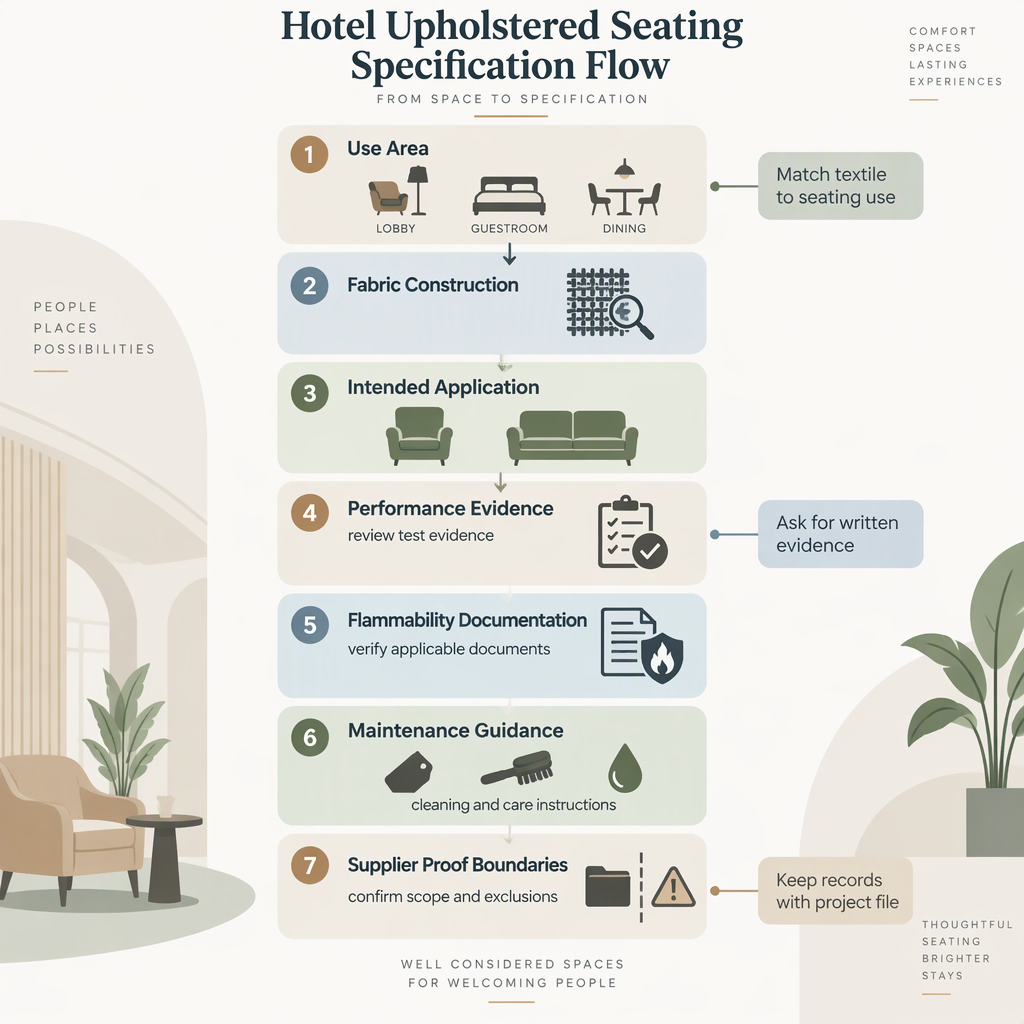
- Define the hotel area, intended application, and use location before approving the upholstery selection.
- Request textile-performance information relevant to flammability, wet and dry crocking, colorfastness to light, physical properties, and abrasion where those topics apply.
- Ask whether the test conditions reflect standard laboratory conditions and whether additional project conditions need review.
- For U.S. covered upholstered furniture, request documentation addressing 16 C.F.R. part 1640, TB 117-2013, and the applicable certification-label requirement.
- Ask whether the compliance approach relies on cover fabric, filling, barrier material, decking material, or another documented construction approach.
- Require current project approvals from the designer, owner, operator, contractor, and local authority where required before issuing a purchase order.
- Keep the approved fabric, seating construction, maintenance guidance, and compliance documents together in the FF&E closeout record.
This checklist keeps the approval process practical. A designer can protect the look, an owner can compare lifecycle risk, procurement can request comparable submittals, and the contractor can avoid installing seating before required documentation is complete.
Separate General Standards From Supplier-Specific Proof
General guidance can define what to ask for, but supplier-specific performance, certification, warranty, lead time, and project suitability should come from current supplier documents.
- Use textile guidance to define the performance questions that belong in the submittal package.
- Use the CPSC FAQ to frame U.S. covered-furniture flammability and label questions, then confirm the project’s jurisdiction and scope.
- Do not rely on marketing language alone for certification, durability, code compliance, warranty, price, production capacity, or delivery timing.
- Ask suppliers to identify the exact product, fabric, construction, test document, date, and project assumptions behind any performance claim.
For comparison selection, this boundary is helpful rather than restrictive. It lets hotel owners, FF&E buyers, designers, and contractors compare seating options on the same evidence categories without assuming that every general rule automatically applies to every product.
Conclusion
The strongest hotel upholstered seating specification starts with intended use and documented performance, then adds jurisdiction-specific compliance checks before procurement approval.
Color still matters, but it should come after the team defines the seating area, fabric construction, application, use location, and relevant textile-performance topics.
For U.S. covered upholstered furniture, add flammability and label documentation to the approval package. For global projects, confirm the current local rules and hotel-brand requirements before the purchase order is released.
FAQ: Hotel Upholstered Seating Specifications
These questions help owners, FF&E procurement teams, designers, and contractors compare upholstered hotel seating on evidence, not swatch preference alone.
Is abrasion alone enough to choose hotel upholstery?
No. ACT lists abrasion among several textile-performance topics, alongside flammability, wet and dry crocking, colorfastness to light, and physical properties. Treat abrasion as one input, not the whole specification.
Does 16 C.F.R. part 1640 require flame-retardant chemicals?
The CPSC FAQ states that the regulation does not specify or prohibit the use of flame-retardant chemicals to meet the requirements. Buyers should request the compliance documentation for the actual covered item and construction.
What should be approved before the final fabric color?
Approve the intended application, use location, fabric construction, and relevant textile-performance evidence before treating the color as final.
How should lobby seating differ from guestroom seating in the specification?
The specification should name the use location and application. A lobby may put more emphasis on public-area exposure, while a guestroom chair still needs documented performance for its intended use and maintenance plan.
What U.S. flammability documents should a contractor ask for?
For covered U.S. upholstered furniture, ask for documentation addressing 16 C.F.R. part 1640, TB 117-2013, and the applicable federal certification-label requirement.
Can a supplier’s brochure replace test documents?
A brochure can help identify the proposed product, but the approval package should include the relevant performance documents and the conditions behind them.
Should the same flammability rule be used for every country?
No. The CPSC source supports a U.S. discussion. For non-U.S. hotels, confirm the current local rules, project authority requirements, and operator standards before approval.
What is the most useful RFQ question for hotel upholstered seating?
Ask the supplier to connect the proposed seating to the intended hotel area, fabric construction, application, use location, and documented performance topics. That creates a comparable basis for selection.


