


Start With the RFQ Scope Suppliers Must Price
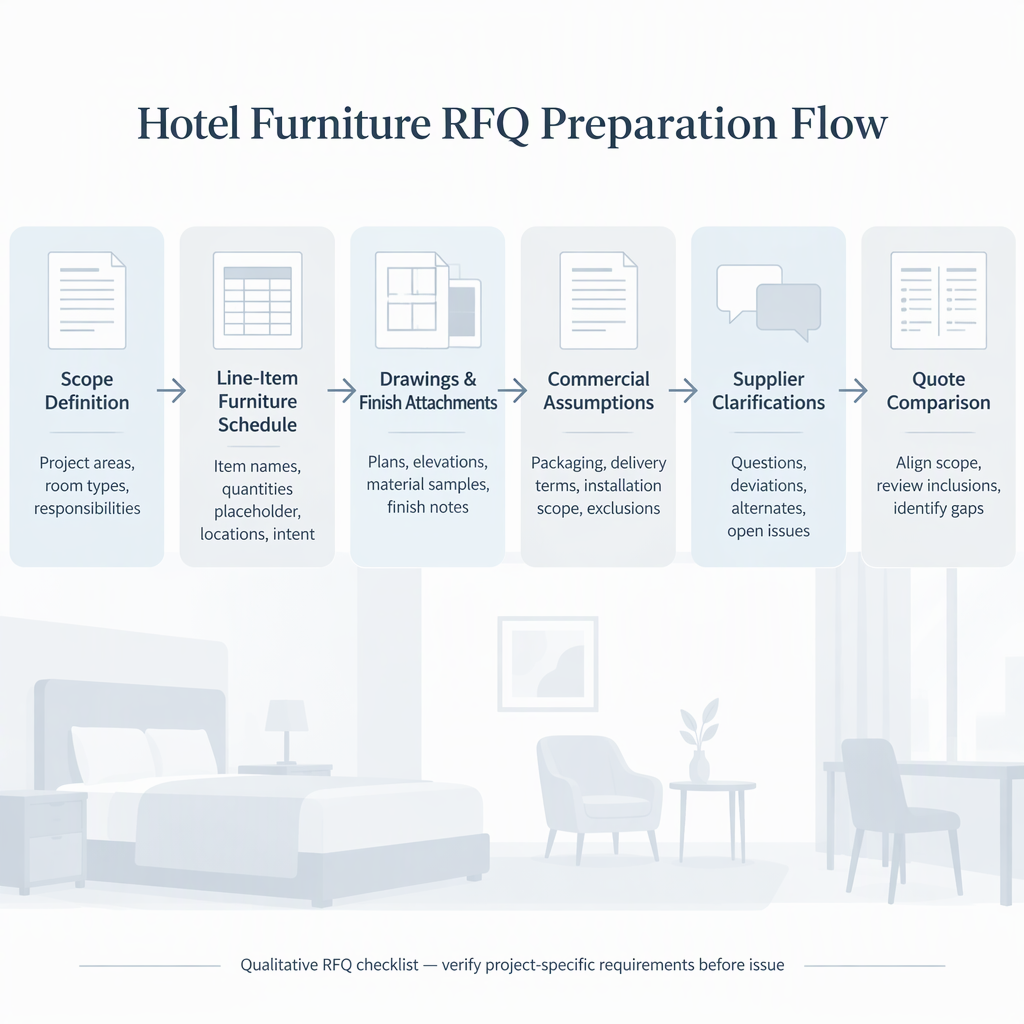
State what suppliers must price: project areas, item categories, controlling documents, response format, and commercial assumptions. The U.S. General Services Administration maintains an official Request for Quotation form reference, which supports using an RFQ as a structured procurement document.
- Name the procurement method clearly as a Request for Quotation; UNDP also identifies Request for Quotation as a procurement-method template in its policy area.
- Define the pricing objective: comparable supplier responses that can be reviewed for value, efficiency, transparency, and fairness.
- Separate the hotel areas to be quoted, such as guestroom, lobby or public-area, restaurant or banquet, bathroom-related furniture, serviced-residence, and related FF&E categories.
- Tell suppliers whether they should price supply only, supply with packaging and shipping, or supply with installation support if that scope is part of the request.
- State what is excluded so suppliers do not hide different assumptions inside their prices.
Build a Line-Item Hotel Furniture Schedule
Create one schedule that separates each item by area, code, quantity, finish direction, drawing reference, and pricing unit. Categories can span guestrooms, public areas, restaurants, banquet spaces, bathrooms, serviced residences, casegoods, surfaces, flooring, and shower-panel-related FF&E.
| Schedule field | What the buyer should provide | Why it matters for pricing |
|---|---|---|
| Area or room type | Guestroom type, lobby, restaurant, banquet room, corridor, bathroom area, or serviced-residence space. | Suppliers can group similar items and avoid mixing unlike furniture scopes. |
| Item code and quantity | A unique item code, quantity, unit, and whether spares or mock-up pieces are included. | Comparable quantities help buyers compare supplier prices on the same basis. |
| Drawing or image reference | Plan, elevation, shop drawing, sketch, mood board, or reference image name. | Suppliers can connect the price to the intended design instead of guessing from a description alone. |
| Material and finish direction | Wood, metal, stone, upholstery, panel, flooring, top, hardware, or finish notes where applicable. | Material choices affect sourcing, fabrication assumptions, packaging, and sample approval. |
| Supplier response field | Unit price, total price, inclusions, exclusions, proposed alternates, and validity period. | The buyer can identify mismatched assumptions before selecting a supplier. |
- Keep guestroom casegoods, loose furniture, bathroom furniture, public-area furniture, restaurant or banquet furniture, and special surfaces in separate rows.
- Use the same item codes in drawings, schedules, quotation templates, and clarification logs.
- Ask suppliers to mark any deviation from the RFQ schedule rather than embedding it silently in the price.
Define Each Furniture Item Without Forcing Guesswork
Each line should tell the supplier what to price, how to measure it, which design information controls, and how to respond to proposed alternatives. This turns a hotel furniture RFQ from a list into a comparable pricing package.
| If the item is... | Include in the RFQ | Ask the supplier to return |
|---|---|---|
| Custom casegoods or built-in furniture | Dimensions, drawings, finish direction, hardware notes, installation interface, and packaging expectations. | Unit price, included hardware, finish assumptions, drawing exceptions, and required clarifications. |
| Loose furniture for guestrooms or public areas | Quantity by room type or area, reference image, material direction, upholstery or finish notes, and packaging scope. | Unit price, proposed material basis, exclusions, and any alternative construction suggestion. |
| Bathroom furniture, tops, panels, or related surfaces | Location, dimensions, material direction, edge or fixing notes if known, and interface with other trades. | Unit price, included accessories, packing method, and assumptions that affect installation. |
| Any item with uncertain information | Known data, open questions, deadline for clarifications, and whether alternates are allowed. | A priced base offer plus separately stated assumptions or options. |
Control Drawings, Finishes, and Sample Approvals
Attach the latest design documents, identify the quotation-control version, and describe finish and sample review before production. A customization workflow can include requirement and budget analysis, design development, material selection, sample approval, production, quality control, packaging, shipping, and installation support.
- Issue a drawing register that lists each drawing, revision, date, and related furniture item code.
- Create a finish schedule that links material, color, surface, hardware, upholstery, top, flooring, or panel references to the correct item rows.
- Define the sample path: what sample is required, who reviews it, what approval means, and whether pricing must include sample production or shipping.
- Set one clarification deadline so all suppliers receive the same answers before final quotation submission.
- Record accepted alternatives separately from the base RFQ so the buyer can compare like with like.
- Attach drawings rather than relying only on room names.
- Match every finish note to an item code.
- State whether supplier alternates are permitted, prohibited, or allowed only as optional addenda.
- Require suppliers to list assumptions that are not shown in the RFQ documents.
State Commercial and Logistics Terms That Affect Price
Include commercial and logistics terms because they affect the quotation. Ask every supplier for the same pricing basis before comparing totals.
- Pricing basis: currency, unit price format, taxes or duties treatment, quote validity, and whether alternates must be priced separately.
- Scope basis: supply only, supply and packing, supply and freight, supply and installation support, or another defined combination.
- Packaging basis: packaging expectations for furniture, surfaces, panels, or other FF&E items that need protection during shipping and handling.
- Delivery basis: required destination information, delivery batches, storage assumptions, and responsibility for unloading if applicable.
- Approval basis: sample, shop drawing, finish, or mock-up review points that must happen before production release.
- Clarification basis: deadline for questions, response channel, and whether verbal answers are valid.
Compare Supplier Quotes on the Same Basis
Compare suppliers against the same RFQ scope before ranking prices. A low total is not comparable if it excludes drawings, samples, packaging, delivery assumptions, or quantities another supplier included.
| Check | Question to ask | Buyer action |
|---|---|---|
| Scope match | Did the supplier quote every required item code and quantity? | Request a corrected response or record missing lines before comparison. |
| Specification match | Are materials, finishes, drawings, and sample assumptions aligned with the RFQ? | Separate approved alternates from the base offer. |
| Commercial match | Are currency, tax treatment, validity, packing, freight, and installation assumptions comparable? | Normalize the comparison table or ask for a revised offer. |
| Clarification record | Did the supplier rely on assumptions not accepted by the buyer? | Confirm or reject assumptions in writing before selection. |
| Value basis | Does the offer support value, efficiency, transparency, and fairness in the purchasing decision? | Document the reason for shortlisting, negotiation, or rejection. |
- First, check completeness against the RFQ schedule.
- Second, separate base prices from optional alternates.
- Third, normalize commercial assumptions before comparing totals.
- Fourth, send a written clarification round when responses are not comparable.
- Finally, document the selection rationale.
Final Hotel Furniture RFQ Checklist
Before sending a hotel furniture RFQ, check that suppliers can price without private assumptions. The goal is not a longer document; it is a clearer, comparable one.
- The RFQ title, project name, response deadline, and quotation format are clear.
- Furniture and FF&E categories are separated by area and item code.
- Quantities, dimensions where known, drawings, finishes, material direction, and sample requirements are linked to the right line items.
- Inclusions, exclusions, alternates, assumptions, and clarification procedures are stated.
- Commercial terms that affect price are defined consistently for all suppliers.
- The quote-comparison template asks for unit prices, totals, deviations, and optional alternates in the same format.
- The evaluation team knows how it will compare value, completeness, transparency, and fairness before responses arrive.
A strong RFQ makes differences visible: what is included, what is excluded, what is assumed, and what must be clarified before selection.
For hotel furniture and FF&E, the most useful preparation work is usually the schedule: item codes, areas, quantities, drawings, finishes, samples, packaging, and delivery assumptions.
Conclusion
A hotel furniture RFQ is priceable when it gives suppliers a shared basis for scope, specifications, approvals, and commercial assumptions. Build the package around the information needed to compare responses fairly, then require suppliers to declare any deviation instead of hiding it inside the price.
For hotel owners, FF&E purchasers, designers, and contractors, the best RFQ discipline is consistency: one schedule, one drawing register, one clarification process, and one quote-comparison format for every supplier.
FAQs About Hotel Furniture RFQs
These questions help buyers turn a hotel furniture RFQ into a clearer procurement package before it is sent to suppliers.
Is an RFQ the same as an RFP or tender?
No. An RFQ is commonly used to request quotations against a defined scope or template. An RFP or tender may involve broader proposal, qualification, or contract procedures, so use the document type that fits your project rules.
How detailed should a hotel furniture RFQ be?
It should be detailed enough for suppliers to price the same quantities, specifications, documents, and commercial assumptions. If information is not final, state the base assumption and ask suppliers to price exceptions separately.
Do suppliers need drawings before quoting hotel furniture?
For custom casegoods, bathroom furniture, surfaces, panels, or location-specific items, drawings or clear references reduce guesswork. For simpler loose furniture, reference images, dimensions, quantities, materials, and finish direction may still be needed.
Should sample approval be included in the RFQ?
Yes, when samples affect design approval, materials, finishes, or production release. The RFQ should say what sample is required, who reviews it, and whether sample cost or shipping is included in the quoted price.
Should the buyer choose the lowest hotel furniture quote?
Not automatically. First check whether each supplier quoted the same scope, quality assumptions, packaging, delivery basis, alternates, and exclusions. A lower price that omits required work is not a like-for-like comparison.
How should RFQ clarifications be handled?
Set a written question deadline, share accepted answers consistently, and require suppliers to identify any remaining assumptions in their quotation. This supports a more transparent comparison.
Can the RFQ include hotel-brand standards?
Yes, if the owner or brand team provides the current applicable documents and approval rules. Do not paraphrase brand standards from memory; attach the controlling documents or state exactly who will provide them.


