English
Views: 0 Author: Site Editor Publish Time: 11-11-2026 Origin: Site

Hotel furniture packaging should be specified from the actual distribution hazards, furniture vulnerabilities, handling points, and documented acceptance criteria—not from carton material alone. If freight may move through less-than-truckload handling, the packaging plan should also account for carrier packaging rules, damage exposure, and claims documentation.
A damage-control plan should start by comparing the expected shipping and handling hazards with the specific vulnerabilities of each furniture item, then matching packaging, tests, and acceptance criteria to that route.
For hotel furniture packaging, the practical question is not “Is the box strong?” but “What can happen to this packed item before it reaches the guestroom?” ISTA’s design guidance frames transport packaging around supply-chain hazards, product vulnerability, test selection for the distribution environment, and documented results through its packaging design and testing guidance.
Observed risk | Likely packaging control to specify | Buyer check |
|---|---|---|
Repeated handling, transfers, or mixed freight exposure | Protect edges, corners, surfaces, legs, and protruding hardware according to the expected route. | Ask how the packed item is intended to withstand the stated distribution environment. |
A fragile finish, glass, stone, mirror, veneer, or shaped component | Separate contact surfaces, restrain movement inside the package, and define acceptable cosmetic condition on arrival. | Require photos or inspection notes that show the packed item before dispatch. |
LTL movement or carrier transfers | Clarify packaging obligations, palletization expectations, handling marks, and claim-documentation steps. | Confirm the freight method and ask the shipper to align the packaging plan with applicable carrier requirements. |
NMFTA describes its LTL Packaging Program as addressing LTL packaging standards, research, education, and advisory services to reduce freight damage and claims, and it identifies NMFC Items 100 through 999 as packaging rules that define shipper packaging obligations and liability exposure in damaged-freight situations. Review the NMFTA Packaging Program when LTL freight is part of the route.
Before shipment, buyers should specify the furniture vulnerability, intended distribution route, package configuration, inspection evidence, label fields, and acceptance criteria that will be used to judge whether the package is suitable.
A useful factory-stage specification gives suppliers and freight partners a common target. It does not need to promise a damage-free result; it needs to make the package design, handling assumptions, and inspection criteria explicit.
List item-level vulnerabilities, such as exposed finish, glass, stone, mirrors, hardware, legs, arms, drawers, or unusual shapes.
Define the expected transport environment: full container, consolidated freight, LTL transfer, local delivery, storage, or multiple handoffs.
Require packaging details for outer protection, internal restraint, separation between components, edge and corner protection, and moisture exposure controls where relevant.
Set documented inspection criteria, including what photos, labels, package-condition notes, and exception reports should exist before dispatch.
Ask whether pre-shipment distribution testing is appropriate for high-value, fragile, custom, or repeat-program items.
Structured package identifiers and logistics labels can support visibility across trading partners, but GS1 US presents its cited guidance for the food industry rather than as a hotel FF&E requirement. For hotel projects, use the same principle carefully: make each package traceable to a room, area, item, and receiving record.
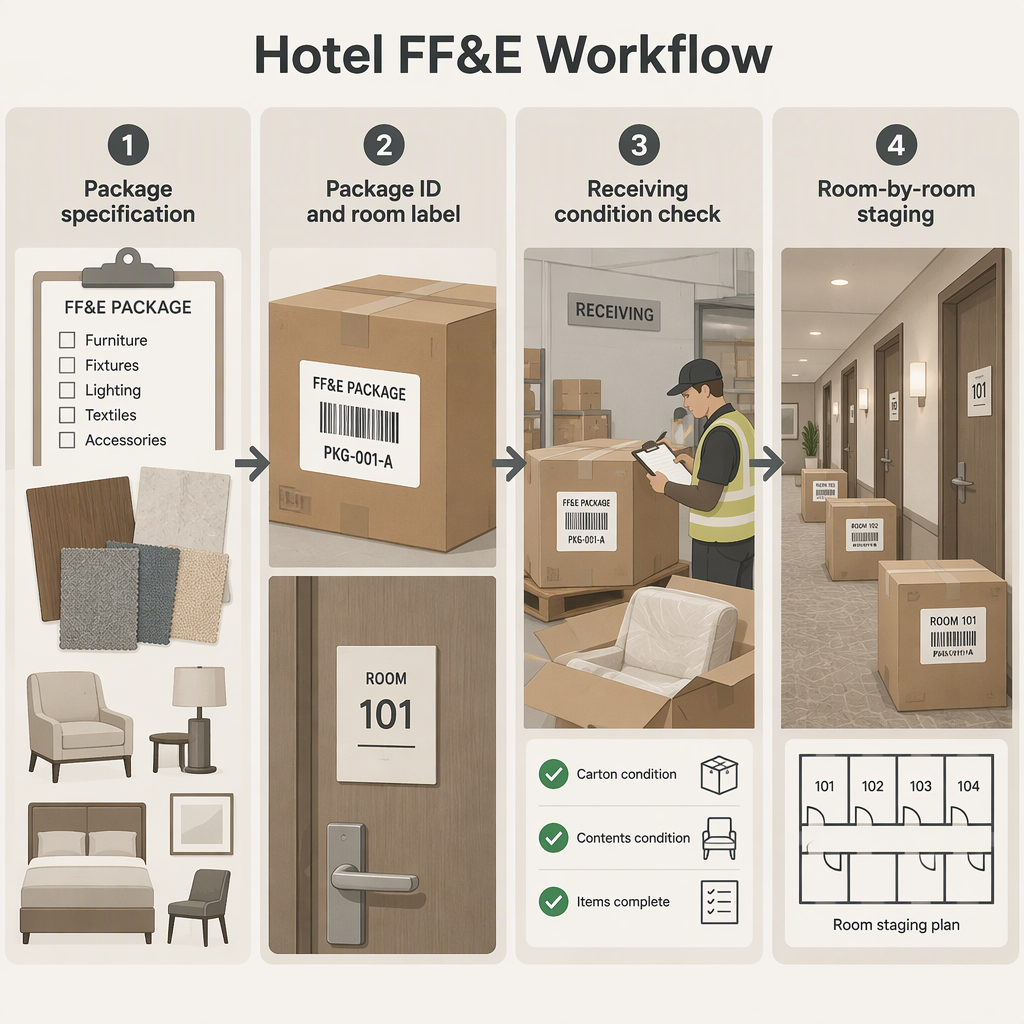
Assign each package a unique package ID that appears on the package, packing list, receiving log, and room-by-room installation schedule.
Include project-useful fields: hotel area, floor, room number or zone, item code, quantity, package count, orientation mark, and handling note.
Group packages by installation sequence when possible, so the receiving team can stage guestroom, corridor, lobby, restaurant, and back-of-house items without opening every carton.
Keep a receiving scan, photograph, or manual log against the package ID before moving the package from dock to staging area.
Record exceptions against the same ID if a carton is crushed, wet, opened, missing, or assigned to the wrong room.
Do not treat a logistics-label example from another industry as a hotel mandate. Use it as a visibility concept, then align the actual fields with the project’s FF&E schedule, contractor workflow, and owner approval process.
At receiving, the site team should check package condition, freight exceptions, label accuracy, and room assignment before unpacking or moving furniture deep into the property.
Inspect the outside of each package at the delivery point for crushing, punctures, wet areas, broken pallets, missing labels, or signs of re-taping.
Record freight exceptions immediately according to the carrier’s current claim and documentation process.
Match the package ID to the purchase order, packing list, room matrix, and installation zone before staging.
Move packages to the planned room, floor, or holding area only after the item identity and package count are confirmed.
Escalate mismatches before opening multiple packages, because mixed room assignments can create extra handling and raise the chance of finish damage.
Receiving symptom | Immediate action | Why it matters |
|---|---|---|
Room number missing or unreadable | Hold the package in a controlled staging area and reconcile it with the packing list. | Prevents the wrong casegood, chair, or headboard from being carried to the wrong room. |
Outer carton or pallet is visibly damaged | Photograph the condition, note the exception, and follow the carrier’s current claim procedure. | Preserves documentation before the package is moved or unpacked. |
Package count does not match the room matrix | Pause distribution to that room set and resolve the discrepancy with procurement and the installer. | Reduces re-handling and avoids opening items out of sequence. |
Request packaging testing or an independent packaging review when the item value, fragility, distribution complexity, or repeat-order volume makes a packaging failure costly to the project.
Pre-shipment testing is a decision tool: it helps compare a package design with a defined distribution environment and acceptance criteria, but it should not be used as a blanket guarantee of zero damage.
Testing is especially useful for new custom designs, mixed-material furniture, fragile finishes, heavy or awkward items, and repeat hotel programs where the same packaging decision may be used across many rooms. Ask the supplier or packaging professional which current test procedure fits the actual route, handling method, and item vulnerability.
ISTA guidance emphasizes selecting test procedures based on the distribution environment and documenting results and criteria. Buyers can use the ISTA design and testing page to frame questions for the supplier, freight forwarder, or packaging engineer.
A buyer-ready packaging checklist should connect package protection, freight method, label fields, receiving evidence, and room-by-room staging responsibilities in one document.
Define the furniture item, finish, dimensions, vulnerable components, and acceptable arrival condition.
State the anticipated distribution path and whether the package may face LTL handling, consolidation, storage, or multiple site transfers.
Ask the shipper and freight partner how packaging responsibilities and claims documentation will be handled for the chosen freight mode.
Require a package ID that matches the purchase order, packing list, room matrix, and installation schedule.
Specify visible labels for room, floor, area, item code, carton count, handling orientation, and exception recording.
Set inspection evidence requirements before dispatch and at receiving, including photos where appropriate.
Identify which high-risk items need packaging testing, sample-pack approval, or specialist review before full shipment.
Use this checklist as an RFQ attachment and require each bidder, freight partner, and installer to confirm which responsibilities they accept before furniture is released for shipment.
General hotel furniture packaging guidance can support better questions and clearer specifications, but it should not be read as proof of a supplier’s certifications, test results, damage rate, delivery time, production capacity, or project outcome.
Transport-packaging principles apply only when the package design is matched to the actual distribution environment, product vulnerability, and documented criteria.
LTL packaging guidance is relevant when the shipment enters that freight environment, but buyers should confirm the current carrier and classification requirements for the actual shipment.
Logistics-label guidance from another industry can help buyers think about traceability, but hotel teams should define their own room, floor, item, and receiving fields for the project.
The strongest hotel furniture packaging plan connects hazards, vulnerabilities, package design, testing decisions, and documented acceptance criteria. For room-by-room distribution, the same plan should make every package identifiable from dispatch through receiving and staging.
Start with the route, handling points, and item vulnerabilities.
Specify labels and package IDs before dispatch, not after arrival.
Document package condition and freight exceptions at the receiving point.
Ask for testing or specialist review when risk justifies the added step.
The goal is to match package design to the furniture’s vulnerabilities and the expected distribution hazards, then define how suitability will be judged before shipment.
No. A stone-top vanity, upholstered chair, mirror, headboard, and casegood may have different vulnerabilities, so packaging should be specified by item type and route.
Room-by-room labeling helps the receiving and installation teams connect each package to the correct floor, room, item code, and installation sequence before unnecessary handling begins.
The cited GS1 US logistics-label guidance is for the food industry, so hotel teams should treat it as a traceability concept rather than a hotel FF&E requirement.
Buyers should consider testing when the furniture is fragile, high value, custom, difficult to replace, or moving through a distribution route where failure would be costly.
The receiving team should document visible package condition, freight exceptions, package ID, carton count, and any mismatch with the packing list or room matrix before moving items into the hotel.
No. A checklist helps buyers ask better questions and assign responsibilities, but supplier certifications, test reports, service scope, and performance claims should come from current supplier documents.