English
Views: 0 Author: Site Editor Publish Time: 19-11-2026 Origin: Site

A hotel FF&E punch list works only when every outstanding item has one clear description, one owner, one agreed rectification route and one dated closure record, and when pre-handover defects are closed before they drift into the later defects period.
A hotel FF&E punch list is a room-by-room or trade-by-trade record of faults, incomplete work and non-conforming items — including furniture, fixtures and equipment, and separate finishes — that must be rectified before the relevant area is certified as practically complete.
At handover most FF&E items are patent defects: conditions a reasonable inspection can see, such as a damaged edge, a misaligned door, a missing shelf or a finish that does not match the approved sample.
The list is a management record, not the certificate itself. It should be issued by the certifying authority identified in the contract, typically the architect, contract administrator or employer agent, and it should be organised by room or by trade so that each item can be traced.
Do not use the punch list as a holding area for work that should have been finished before handover. A separate defects period begins after practical completion and has its own schedule and certification process.
An actionable FF&E punch item records what is wrong, where it is, what acceptable completion looks like, who must act and what dated evidence will close it; meticulous records with acknowledgements matter more than a long narrative.
Describe the defect against the approved specification, drawing, sample or mock-up rather than against personal taste. That keeps the item within the contract definition of a defect and gives the contractor a clear standard to meet.
Room number, area, FF&E item and unique item reference, including a photograph reference where useful.
Observed condition and the approved requirement it fails, such as finish, dimension, alignment, operation or completeness.
Defect category and responsible trade or supplier, so the item routes to the right rectification owner.
Date inspected, inspector and the date the record was sent to the contractor.
Agreed rectification action, access requirement and target completion date.
Closure method and verifier, with space for a dated acknowledgement rather than an informal message.
Inspect only when the area has had a builder clean, protective material has been removed and full permanent lighting is operating; if those conditions are not met, record the area as not ready instead of producing a list that will be disputed.
Readiness condition |
Ready to inspect? |
What to record if not ready |
|---|---|---|
Builder clean completed and dust-generating work stopped |
Yes |
Cleanliness hold and the area or trade still working |
Protective covers, films and site protection removed |
Yes |
Protection still installed, with the room and item affected |
Full permanent lighting operating |
Yes |
Lighting not commissioned or temporary lighting in use |
Safe access and area released by the contractor |
Yes |
Access restriction and the person who released the area |
Large projects may be inspected in sections as areas complete |
Section only |
Area boundaries and the completion status of adjacent work |
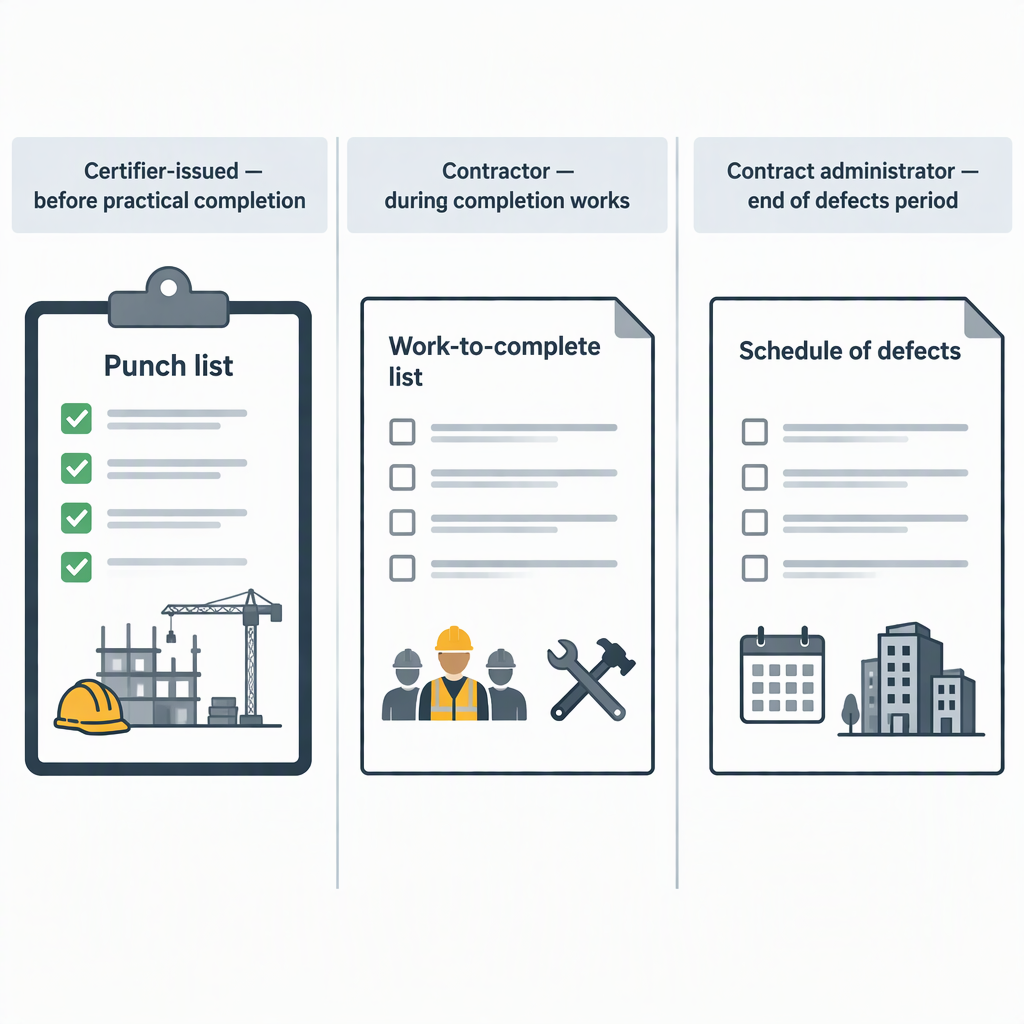
Sort each item by author, timing and contractual purpose: the certifier-issued punch list controls pre-completion acceptance, the contractor work-to-complete list controls crew sequencing, and the schedule of defects belongs at the end of the defects period.
Record |
Who normally issues it |
Timing |
Purpose |
Close-out route |
|---|---|---|---|---|
Punch list |
Certifying authority, typically architect, contract administrator or employer agent |
Close to the end of construction, before practical completion |
List faults and non-conforming work to be rectified before certification |
Contractor rectifies; certifier verifies and records closure |
Work-to-complete list |
Contractor or subcontractor |
During construction and fit-out |
Coordinate remaining work and trades |
Crew completes; site supervisor verifies internally |
Schedule of defects |
Contract administrator at the end of the defects period |
At the end of the defects liability or rectification period |
List unrectified items and agree rectification dates |
Contractor rectifies; certificate of making good defects follows |
Snag list is often used as an informal synonym for punch list, but snagging has no agreed contractual meaning. Use the defined term in the contract and define the inspection scope in the project protocol.
The certifying authority issues and controls the punch list, the contractor owns rectification of its scope, the designer confirms the specified requirement, and the owner or FF&E procurement lead verifies package completeness and retains the closure record.
Item type |
Document owner |
Rectification owner |
Verification and sign-off |
|---|---|---|---|
Installed FF&E that does not conform to specification |
Certifying authority |
Contractor or relevant package supplier |
Certifier verifies against the contract; owner receives the closure record |
Missing, damaged or incomplete FF&E item |
Contractor or FF&E package manager |
Supplier, installer or contractor |
Package manager checks delivery and installation; certifier accepts the completed work |
Finish, sample or mock-up mismatch |
Designer or FF&E procurement lead |
Supplier or contractor |
Designer confirms the approved reference; certifier records acceptance |
Statutory health and safety duty |
Not a punch-list item |
Relevant statutory dutyholder |
Refer to the project health and safety file and dutyholder arrangements |
Statutory roles sit outside the contractual punch list. The Health and Safety Executive CDM 2015 dutyholder guidance identifies commercial clients, designers, principal designers, principal contractors, contractors and construction workers as having legal duties of their own.
The UK Construction Playbook illustrates how a client can codify delivery and commercial expectations in a structured way. On a hotel project the transferable discipline is to write the decision route for each outstanding item into the contract administration, not to rely on site emails.
Close items in a controlled sequence: freeze the list, agree the rectification method and access, complete the work, verify it jointly, record the dated acceptance and update the room register before the next inspection.
Issue one controlled list with a revision number and stop adding verbal items that are not recorded.
Agree the rectification action, access window and target date with the responsible contractor or supplier, and record any temporary protection needed for adjacent finishes.
Complete the work and require the contractor to self-check against the stated acceptance standard before requesting reinspection.
Reinspect the item in the same conditions as the original inspection and record pass, fail or partial completion with reasons.
Close the item only when the authorised verifier signs and dates the record, with the evidence attached.
Update the room or package register and carry only genuinely open items into the next handover report.
Retain the closed record with the handover documentation so that later defects can be distinguished from incomplete close-out.
Closure is proven by a dated record that identifies the item, states what was done, names the verifier and carries an acknowledgement; photographs help but do not replace that record.
Before and after photographs that clearly show the item reference, location and date.
A signed and dated acceptance from the person authorised to verify that trade or package.
Confirmation that operation, alignment, finish and completeness now meet the approved reference.
A link from the closure record to the original item number, drawing, sample or mock-up.
A clear note of any item rejected at reinspection, with the reason and the next agreed date.
A retained handover pack that separates closed punch items from defects that arise later.
Do not use the defects liability period as a holding area for pre-handover FF&E defects; close non-conforming work before certification, or use the contract mechanism for a formally attached minor-omissions list if the certifier and contract permit it.
In UK-style contracts, the defects liability period, called the rectification period in JCT contracts including the 2024 edition, begins on certification of practical completion and typically lasts six to twelve months. At its end the contract administrator prepares a schedule of defects listing unrectified items and agrees rectification dates.
Practical completion is the point at which construction work is certified as practically complete under the building contract. Certification releases half of the retention, ends the contractor's liability for liquidated damages and starts the defects liability period.
The RIBA Plan of Work 2020 organises briefing, design, construction and operation into eight stages with defined information exchanges, which helps separate handover information from a punch list.
Confirm the applicable definition, retention mechanics and period in the signed contract and local law.
Before accepting a room or FF&E package with open items, verify who issued the list, who owns each item, what evidence will close it, whether any minor-omissions list is formally attached to the certificate, and which handover documents the owner will receive.
Confirm that the punch list is issued by the certifying authority and uses the contract definition of a defect.
Check that every open item has one owner, one target date and one stated acceptance standard.
Require dated closure records and reinspection evidence, not only photographs or verbal assurances.
If a minor-omissions list is attached to practical completion, record exactly which items are on it and how they will be closed.
Confirm the handover pack, building manual, user guide, health and safety file and log book that the project will issue.
Record the defects period start date and the route for defects that appear after opening.
Keep the closed punch-list register with the FF&E asset records so that warranty, maintenance and future inspections can use it.
The value of a hotel FF&E punch list comes from dated, acknowledged closures that a later reader can trust, not from the length of the list or the software used to produce it.
Keep one controlled register, separate pre-handover defects from the later defects period, and require a named verifier to close each item against the approved standard.
Record each item so that a contractor can act without asking what was meant.
Triage by author, timing and contractual purpose before adding more rows.
Close with a dated acceptance and keep the record with handover information.
Use these answers to test a project close-out process before the next room inspection.
They are often used interchangeably, but snagging is a slang industry term with no agreed contractual meaning. Use the defined term in the contract, and set out the inspection scope, room coverage and sign-off route in the project protocol.
Contract practice sometimes allows a certificate of practical completion to be issued with an attached list of minor omissions and defects to be dealt with in the defects period. Whether your hotel can open with open items depends on the contract, the certifier, the operator and the local authorities, so obtain written confirmation rather than relying on a general practice.
No. The defects period starts at practical completion and deals with defects that arise or remain under its terms. Pre-handover non-conforming work should be corrected before certification unless the contract and certifier formally agree a minor-omissions list.
UK construction practice guidance commonly cites roughly one hour per 100 square metres for a thorough inspection of an area. Treat that only as a planning guide: access, room complexity, FF&E density and reinspection can change the real duration.
No. Photographs are useful supporting evidence, but the closure record should also identify the item, state the rectification, carry a date and include an acknowledgement from the authorised verifier.
Digital tools can produce and track punch lists, but the format matters less than the controls. Choose a method that preserves one item ID, a clear owner, dated status changes, permission controls and a clean export for the handover pack.