English
Views: 0 Author: Site Editor Publish Time: 17-11-2026 Origin: Site

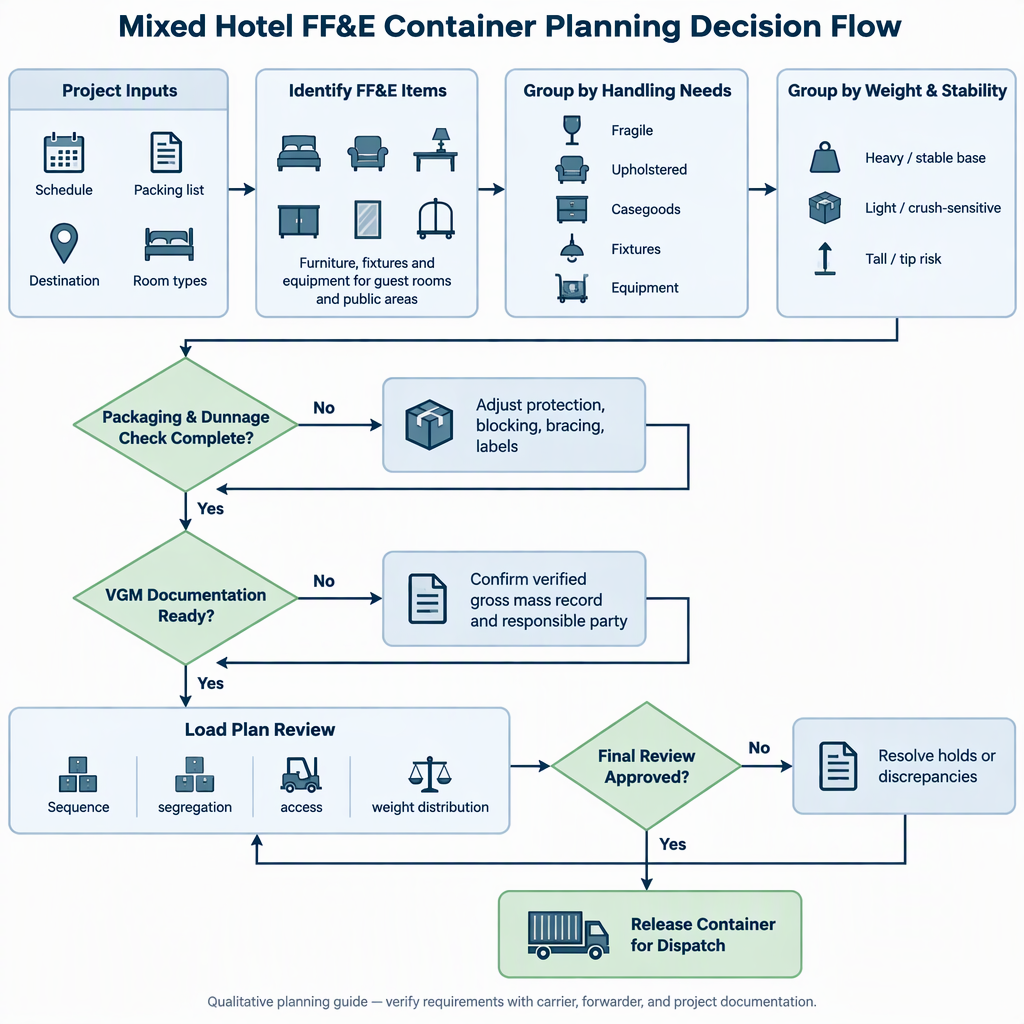
For mixed hotel FF&E orders, a container loading plan is most useful when it turns a packing list into a shipment-readiness map: what goes together, what needs special handling, what packaging or dunnage must be checked, and what weight information must be ready before the packed container is released.
A container loading plan should show how a mixed FF&E order will be packed, positioned and secured inside the cargo transport unit, using practical loading and securing principles from the intermodal container chain.
The IMO/ILO/UNECE CTU Code is a global code of practice for packing cargo transport units for sea and land transport. For a hotel order, its value is not a promise of a specific supplier outcome; it is a planning reference for how cargo should be prepared, loaded and secured before the container moves through more than one transport mode.
Do not treat a loading plan as a substitute for product specifications, structural packing limits, destination import rules or carrier instructions. It should coordinate those inputs, not replace them.
In practice, the plan should make the shipment understandable to the project team: large furniture, boxed fixtures, décor, lighting, spare parts and accessories may all share one container, but they do not all tolerate the same pressure, movement, access sequence or handling method.
Request a loading plan when the shipment mix, handling sequence or securing risk cannot be judged from carton counts and item descriptions alone.
Project condition | Why a loading plan helps | Buyer action |
|---|---|---|
Many FF&E categories share one container | Mixed cargo needs clear loading and securing decisions across the transport chain. | Ask for grouping logic, orientation notes and any non-stackable items. |
Heavy and light goods are combined | Packed-container weight information affects verified gross mass documentation for sea transport. | Confirm who will provide weights and how the packed-container weight will be documented. |
Raw wood dunnage or wood packaging may be used | International movement of raw wood packaging material can fall within ISPM 15 phytosanitary measures. | Check whether regulated wood packaging or dunnage is present and request appropriate markings or documents. |
Installation sequence matters on site | A loading plan can support practical access and handling decisions during transport and unloading. | Share room, floor or phase priorities before final packing is planned. |
A useful plan starts with item, packaging, handling, sequencing and weight inputs from the project team before the container is packed.
Final item list by project area, room type or installation phase, so the loading sequence can support the unloading sequence.
Packed dimensions, gross weights, carton or crate counts, and any orientation marks supplied by the responsible party.
Fragile, non-stackable, high-value, moisture-sensitive or finish-sensitive items that need separate handling decisions.
Items that should remain accessible first at destination, such as site-start packages, installation hardware or inspection samples.
Information on whether raw wood packaging material or dunnage will be used in the shipment.
The party responsible under the shipping arrangement for providing verified gross mass information to the carrier.
Designers and contractors should also flag items whose finish, fabric, glass, stone, metal or electrical components require manufacturer-specific packing instructions. Those instructions should come from the responsible product documentation, not from a generic container plan.
Group items by handling risk, weight, stackability, access priority and packaging type rather than by purchasing category alone.
Grouping lens | Use in the loading plan | Boundary to confirm |
|---|---|---|
Weight and footprint | Helps decide placement, support and securing needs inside the container. | Use actual packed weights and dimensions from project documents. |
Fragility and finish sensitivity | Helps separate crush-sensitive or surface-sensitive goods from incompatible loads. | Follow item-level packing instructions where they exist. |
Stackability | Helps prevent a carton count from being mistaken for a safe stacking plan. | Confirm load limits from the packaging or product owner. |
Raw wood packaging or dunnage | Helps identify whether ISPM 15 checks may be relevant for international movement. | Processed wood such as plywood is outside the covered raw-wood packaging scope described by ISPM 15. |
Unloading sequence | Helps align container access with site installation priorities. | Coordinate with the contractor before container release. |
Avoid approving a plan that groups items only by room name or purchase order if it does not also explain handling, weight and securing logic for the mixed load.
For sea transport subject to SOLAS, verified gross mass is a shipment-readiness requirement: the shipper must provide the verified weight in the shipping document before the packed container can be loaded onto a ship.
The IMO guidance on verification of the gross mass of a packed container states that the shipper is responsible for providing the verified gross mass and that VGM is a condition for loading the packed container onto a ship subject to SOLAS.
A hotel project team should not assume that a loading diagram, commercial invoice or purchase list is enough for VGM. Confirm the responsible shipper, weighing method and documentation path with the forwarder or carrier for the specific shipment.
For mixed FF&E, VGM planning should start before the container door closes: missing item weights, late substitutions and unclear packaging weights can delay the final verified mass process.
Before shipment, check whether the order uses raw wood packaging material or dunnage that may fall under ISPM 15, and separate that check from ordinary carton labeling.
The IPPC publication Regulation of wood packaging material in international trade describes measures for reducing pest risk associated with international movement of wood packaging material made from raw wood, including dunnage, while excluding processed wood such as plywood.
Ask whether pallets, crates, blocking, bracing or loose dunnage include raw wood packaging material.
Check that regulated wood packaging or dunnage is addressed before the container is released for international movement.
Do not assume plywood, cartons or composite packaging need the same treatment as raw wood packaging.
Keep packaging notes connected to the loading plan so that protective materials, blocking and bracing are visible to the review team.
Destination customs, product compliance, fire-safety and import documentation can vary by project. Confirm those rules with the forwarder, importer of record, local authority or compliance adviser for the destination market.
Review the loading plan in a short sequence: confirm the item data, check grouping and securing logic, verify packaging and dunnage issues, confirm VGM responsibility, then release the final version to logistics partners.
Procurement confirms that the item list, quantities, packed dimensions and carton or crate counts match the order to be shipped.
Design and contractor teams flag access sequence, fragile finishes, site priorities and any items that should not be buried behind later-phase goods.
The packing or logistics team checks whether the proposed positions, blocking, bracing and securing approach are suitable for the mixed cargo.
The responsible shipment team checks whether raw wood packaging material or dunnage needs ISPM 15 attention.
The shipper or appointed logistics party confirms the VGM process and shipping-document responsibility before vessel loading.
The project team stores the approved plan with the packing list and shipment documents so the receiving team can compare the delivered load against the plan.
Approve the plan only when it connects the cargo list, handling logic, packaging checks, VGM responsibility and receiving sequence in one reviewable document.
The plan identifies each major FF&E group and shows where it sits in the container.
Heavy, fragile, non-stackable and finish-sensitive items are visibly separated or protected according to project instructions.
Blocking, bracing, securing and access assumptions are clear enough for the logistics team to review.
Raw wood packaging and dunnage questions have been checked where international movement is involved.
VGM responsibility, timing and documentation path are agreed before carrier handoff.
The receiving team has the final plan, not only the commercial packing list.
If this is missing | Do this before approval |
|---|---|
Actual packed weights | Hold approval of shipment-readiness documents until the VGM process can be completed. |
Stackability or fragility limits | Request product or packaging instructions from the responsible supplier or manufacturer. |
Dunnage material description | Confirm whether raw wood packaging material is present and whether ISPM 15 treatment applies. |
Site unloading sequence | Ask the contractor or receiving team to define what must be accessible first. |
For a mixed hotel FF&E order, use a container loading plan when the project needs more than a count of boxes: it should make loading, securing, packaging and documentation responsibilities clear before release.
Treat the plan as a coordination tool for mixed cargo, not as a guarantee of a damage-free shipment.
Check raw wood packaging and dunnage separately from ordinary cartons and labels.
Confirm VGM responsibility early so the packed container can move through the required shipping-document process.
The most useful questions focus on when the plan is needed, what information it needs, and which shipment boundaries must be confirmed by the responsible logistics or compliance party.
No. A packing list records shipment contents, while a loading plan should also explain placement, grouping, access and securing logic for the cargo transport unit.
Mixed orders can combine furniture, fixtures, décor and boxed accessories with different weights, sizes, finishes and handling needs, so carton counts alone may not show how the load should be arranged.
IMO guidance states that the shipper is responsible for providing the verified gross mass in the shipping document. For a specific project, confirm who is the shipper under the contract and booking arrangement.
No. ISPM 15 concerns wood packaging material made from raw wood, including dunnage, and excludes processed wood packaging such as plywood.
No. Exact utilization depends on actual packed dimensions, weights, packaging limits, stacking restrictions and the container type selected for the order.
Procurement, design, the contractor or receiving team, and the logistics party should each review the parts they control: item data, finish and handling needs, site sequence, and transport readiness.
One major risk is approving the load before weight responsibility and VGM documentation are clear, because VGM is a condition for loading a packed container onto a ship subject to SOLAS.