English
Views: 0 Author: Site Editor Publish Time: 23-11-2026 Origin: Site

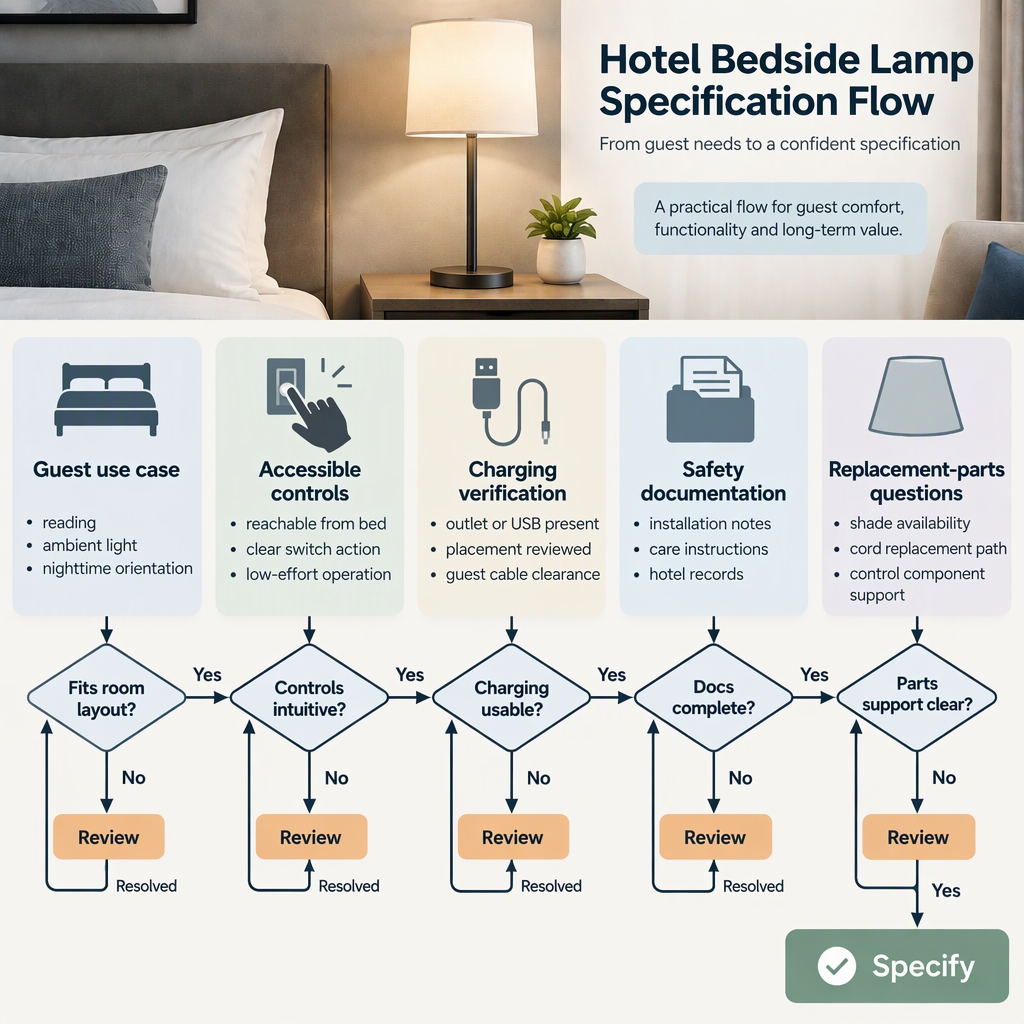
Select hotel bedside lamps by confirming control usability, charging requirements, safety documentation, and replacement-part support before finishes are approved. For accessible U.S. contexts, operable controls should be planned around reach, one-hand use, limited operating force, and no tight grasping, pinching, or twisting. For charging, USB Power Delivery capability depends on the implemented USB PD specification and device power negotiation, not simply on a port shape. For portable electric luminaires, UL 153 provides a current public standards scope that includes portable luminaires powered by branch circuits, USB, or PoE.
Start with how the guest will turn the lamp on, charge a device, and reach controls from the bed; finish style should follow those use decisions.
For hotel bedside lamps, the control decision affects guest comfort, accessible-room coordination, housekeeping replacement work, and contractor installation. ENERGY STAR lodging guidance identifies lighting as an important hotel electricity use and recommends efficient lamps, LEDs, occupancy sensors, timers, and lighting-control strategies for lodging facilities. That does not prove a saving for a specific lamp, but it does make controls part of the FF&E decision rather than a decorative afterthought.
Planning question | What to decide before approval | Buyer action |
|---|---|---|
How will the guest switch the lamp? | Where accessibility rules apply, switches and similar operable parts need reach and operation review. | Show the control location on room drawings and mock-up review notes. |
Will the lamp include outlets or charging? | Separate the lighting function from device-charging expectations so quotes are comparable. | Ask for the charging protocol, port type, and certification evidence. |
Who maintains the lamp after opening? | Parts and module replacement affect operations after turnover. | Request a parts list, ordering path, and replacement instructions in the submittal. |
The 2010 ADA Standards for Accessible Design apply to newly designed, constructed, or altered U.S. state and local government facilities, public accommodations, and commercial facilities, and include transient-lodging guest-room scoping plus technical chapters on reach ranges and operable parts. Confirm the adopted accessibility requirements and local amendments for each project jurisdiction.
For accessible guest rooms, bedside lamp controls should be coordinated with the same reach and operability review used for switches, receptacles, and other guest controls.
The U.S. Access Board guidance on operable parts covers elements such as light switches, electrical receptacles, communication receptacles, thermostats, and similar controls in accessible spaces and along accessible routes. It states that operable parts generally must be within reach ranges, usable with one hand, not require tight grasping, pinching, or twisting, and not require more than 5 lbf of force.
Mark the intended control height and horizontal reach on the room elevation, not only on the furniture schedule.
Confirm that a seated guest can reach the switch or touch control without moving the lamp into an unstable position.
Check that dimmers, rocker switches, pull chains, touch sensors, and integrated charging modules can be operated with one hand where accessibility requirements apply.
Coordinate with nightstands, headboards, wall panels, mattresses, and outlet locations before production approval.
For non-U.S. projects, use the same usability questions while confirming the local accessibility code with the project consultant or building department.
The DOJ 2010 ADA Standards are a U.S. accessibility standard for covered facilities, not a global legal rule. For global hotel programs, treat ADA-based checks as a useful planning discipline and confirm the controlling local code before issuing construction documents.
Do not specify “USB-C” by appearance alone; define the charging outcome, the supported protocol, and the documents that prove it.
USB-IF states that USB Power Delivery enables more flexible power delivery over USB, that USB PD Revision 3.1 enables up to 240 W over full-featured USB Type-C cable and connector, and that powered devices can request only the power they require. This means the procurement question is not only whether a bedside lamp has a USB-C opening. The buyer should ask what power profile the lamp’s charging module supports and what device scenarios it is intended to serve.
Guest expectation | Specification question | Document to request |
|---|---|---|
Basic phone charging | Which port type and output ratings are provided? | Module data sheet and safety listing details. |
USB-C charging | Does the port support USB Power Delivery, or is it only a USB-C connector? | USB PD capability information tied to the installed module. |
Logo or certification claim | Is the claim backed by the USB-IF compliance process? | USB-IF compliance information, Test ID where applicable, Integrators List entry, and logo license evidence when a USB-IF logo is used. |
The USB-IF compliance program uses test specifications and Test IDs to evaluate products; products that pass are considered USB-IF certified, added to the Integrators List, and may license USB-IF logos when trademark requirements are met. Ask suppliers to connect any USB claim to product-specific documentation rather than relying on a generic port description.
A standards name helps define what evidence to ask for, but it does not prove that a specific bedside lamp is certified or listed.
UL Standards & Engagement lists UL 153 Portable Electric Luminaires as ACTIVE, Edition 13, with scope covering portable luminaires for task or ambient illumination connected to nominal 120 V branch circuits and portable luminaires powered through USB or PoE. The same public scope summary includes integral LED components and subassemblies through referenced LED equipment requirements.
Use that scope to frame the submittal review. A hotel owner, designer, FF&E purchaser, or contractor should still ask for product-specific listing, rating-label, installation, and use documents for the exact bedside lamp configuration being supplied.
Where USB logos or USB-IF certification are claimed, USB-IF describes a compliance path based on test specifications, Test IDs, Integrators List inclusion, and trademark requirements. Keep lighting safety documentation and USB compliance documentation separate in the submittal so each claim can be checked on its own terms.
Treat replacement parts as an operating requirement: the RFQ should ask what can be replaced, how it is identified, and how the hotel orders it later.
Bedside lamps sit in high-use guestroom locations, so the parts plan should be practical for housekeeping, engineering, and purchasing teams. Do not wait until a shade, switch, diffuser, charging module, cord, driver, or mounting component fails to discover whether it has a part number.
Request a bill of replaceable parts with part names, part numbers, finish references, and ordering contacts.
Ask whether shades, diffusers, switches, power cords, charging modules, and LED-related service parts are field-replaceable or factory-service items.
Require replacement instructions that match the exact lamp model and configuration.
For any manual access to powered components during inspection, cleaning, or replacement, switch off and disconnect the power source before access, then follow only the manufacturer’s permitted procedure.
Agree on attic-stock quantities for the opening package and define how future replacements will be quoted.
Record whether a substitute part changes appearance, electrical rating, control behavior, or charging capability.
A strong RFQ makes suppliers quote the same control, charging, safety, and replacement-part requirements instead of offering visually similar but technically different lamps.
Identify accessible-room requirements and ask how each switch, dimmer, sensor, or outlet-style feature will meet reach and operability criteria where those rules apply.
State whether the project uses lighting controls such as timers, occupancy sensors, efficient lamps, or LED strategies as part of the lodging energy plan.
For USB charging, define the expected device use and request the exact USB PD or non-PD charging capability of the installed module.
For USB-IF logo or certification claims, ask for compliance evidence connected to the product or module being supplied.
For portable electric luminaires, request product-specific safety documentation instead of treating the existence of UL 153 as proof for the lamp.
Require a replacement-parts schedule, attic-stock recommendation, and procedure for future orders.
RFQ line item | Why it matters | Comparable response format |
|---|---|---|
Control location and type | Supports guest usability and accessible-room coordination. | Marked drawing, switch type, operating method. |
Charging module | Prevents a port-shape-only comparison. | Port type, protocol support, rating, evidence documents. |
Safety listing and ratings | Separates standard scope from the actual product claim. | Listing file, rating label, installation/use instructions. |
Replacement parts | Protects the hotel’s post-opening maintenance plan. | Parts list, part numbers, ordering process. |
The best hotel bedside lamp choice is the one that satisfies the room’s guest-use, accessibility, charging, safety-documentation, and maintenance requirements before procurement is locked.
Plan control reach and operation before approving the lamp style.
Specify charging performance and verification documents, not only USB port appearance.
Ask for product-specific safety documentation for the exact configuration supplied.
Build replacement parts into the RFQ so the hotel can maintain a consistent room appearance after opening.
Before final approval, buyers should resolve the practical questions that affect guest use, code review, charging expectations, and long-term maintenance.
No. USB-IF describes USB Power Delivery as the mechanism for flexible USB power delivery, with PD Revision 3.1 enabling up to 240 W over a full-featured USB Type-C cable and connector. A USB-C connector alone does not tell you the installed module’s power profile.
It depends on the jurisdiction, room type, and whether the project is covered by the applicable accessibility rules. The DOJ 2010 ADA Standards apply to covered U.S. facilities and include transient-lodging scoping and technical reach-range and operable-parts provisions. Confirm requirements with the project accessibility consultant and local authority.
No. UL 153 is an active portable-luminaire standard with a public scope that includes certain branch-circuit, USB, and PoE-powered portable luminaires. A specific lamp still needs product-specific listing or certification evidence.
Controls determine how the guest uses the lamp from bed and how the lamp coordinates with headboards, nightstands, mattresses, outlets, and accessible reach. Finish selection is easier after those constraints are fixed.
USB-IF says products that pass its compliance program are considered USB-IF certified, added to the Integrators List, and may license USB-IF logos when trademark requirements are met. Ask for the product or module documentation that supports the logo claim.
ENERGY STAR lodging guidance points to efficient lamps, LEDs, occupancy sensors, timers, and lighting-control strategies for hotels and motels. A bedside lamp specification should therefore coordinate with the property’s broader lighting-control approach.
Ask for the parts most likely to affect appearance, electrical function, or guest use: shades, diffusers, switches, cords, charging modules, drivers or LED service parts, mounting pieces, and finish-specific hardware.