

For hotel furniture supplier qualification, count a project reference as relevant when it helps you judge scope similarity, the supplier’s actual role, delivery availability, current commitments, risk management, and the experience of key people or subcontractors. Treat past performance as evidence to test reliability, not as automatic proof that a supplier is qualified for your project.

What makes a project reference relevant?
A relevant reference is one that connects the prior project to the work you are buying: comparable scope, clear supplier responsibility, available delivery capacity, risk controls, and experience from the people who would influence your project.
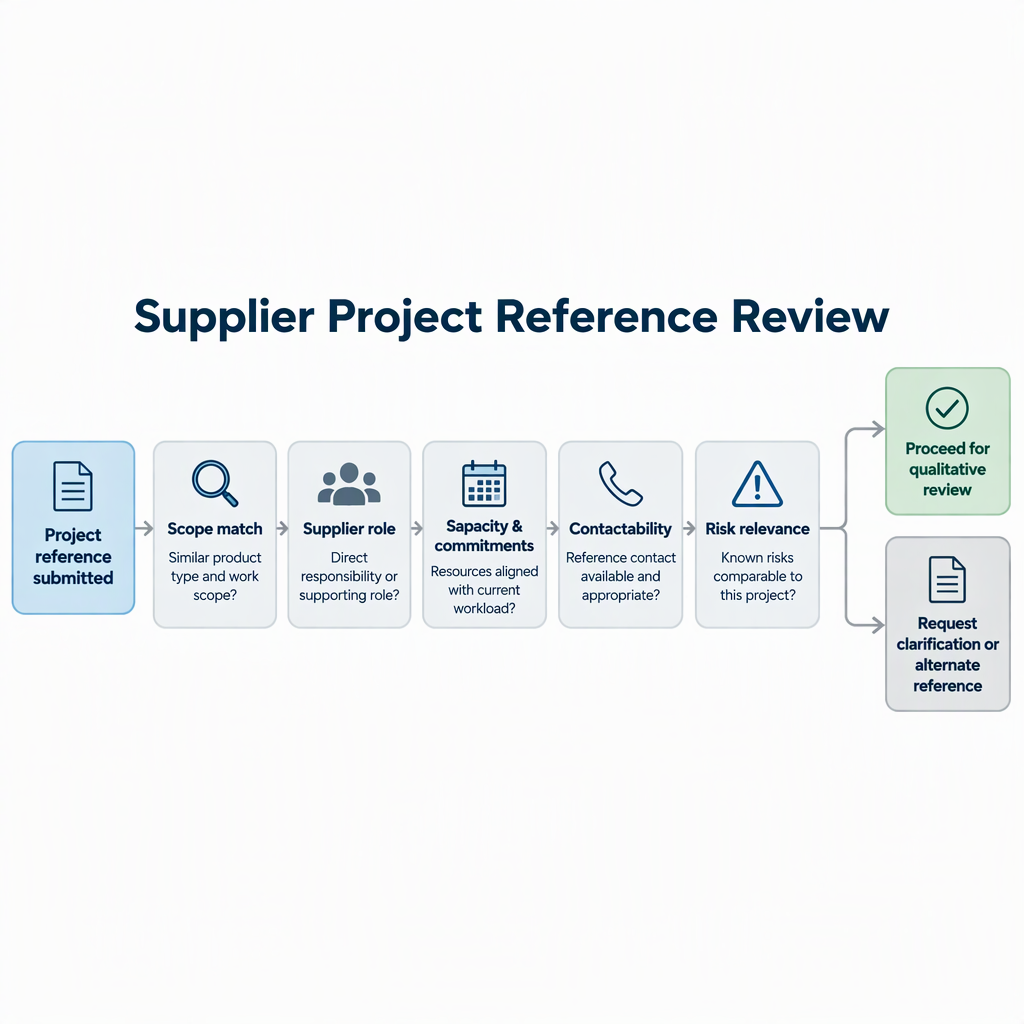
New Zealand Government Procurement guidance says evaluation criteria may include preconditions, value for money, capability, and capacity, and that capability checks may consider track record in similar services, current commitments, delivery availability, risk management, and relevant experience of key personnel or subcontractors. See the official guidance on how to decide evaluation criteria.
| Reference detail | Why it matters | How to use it |
|---|---|---|
| Project scope | A similar service or work type is more useful than an unrelated project name. | Compare the reference with your rooms, public areas, back-of-house items, custom elements, and installation coordination needs. |
| Supplier role | Capability is easier to judge when the supplier’s actual responsibility is clear. | Ask whether the supplier manufactured, sourced, coordinated, installed, or only supplied selected items. |
| Current capacity | Capacity checks may include current commitments and availability. | Ask how the supplier would staff and schedule your project alongside existing work. |
| Reliability evidence | Past performance can be considered as evidence of technical and professional ability, including reliability shown in previous contracts. | Use references to confirm whether the supplier delivered what was agreed, communicated issues, and handled changes responsibly. |
How close should the reference be to the hotel FF&E scope?
The reference does not have to be identical, but it should be close enough to test the same capability and capacity risks you face in the hotel FF&E package.
- Match the type of work: guestroom casegoods, loose furniture, public-area pieces, custom millwork coordination, or another defined package.
- Match the operating context: renovation, new-build, phased opening, occupied property, remote site, or multi-property rollout.
- Match the coordination burden: designer approvals, contractor interfaces, logistics, mock-up review, and documentation flow.
- Match the scale and timing risk: compare the reference to your expected quantity, procurement window, and delivery constraints without assuming the old project proves the new schedule.
What capacity and team fit should be checked?
Check the people, workload, delivery availability, and risk controls behind the reference, because the project name alone does not show whether the supplier can support your live requirement.
- Ask which current commitments may compete for management attention, production coordination, procurement follow-up, or installation support.
- Ask who would manage your account, technical submittals, quality communication, logistics, and issue escalation.
- Ask whether relevant subcontractors or specialist partners would be involved, and what experience those parties bring.
- Ask the supplier to describe risk management for design changes, approval delays, shipment disruption, site access limits, and punch-list resolution.
How much weight should past performance carry?
Past performance should carry meaningful weight as reliability evidence, but it should not replace a balanced review of scope fit, capacity, proposal quality, risk, and current availability.
The GOV.UK procurement policy note on suppliers’ past performance supports considering past performance as evidence of technical and professional ability, including reliability demonstrated in previous contracts.
Use past performance for
- Testing whether the supplier has shown reliability in previous contracts.
- Checking whether the prior work is similar enough to inform capability and capacity.
- Identifying questions about current commitments, availability, and risk management.
Do not use past performance for
- Assuming a supplier has a certification, factory capacity, or product specification that has not been separately documented.
- Automatically excluding newer suppliers when other capability evidence is credible.
- Replacing sample review, technical submittals, commercial review, or contract terms.
How should reference verification work?
Verify references by moving from the supplier’s project list to comparable scope, confirmed role, contactable evidence, capacity fit, and documented risks before shortlisting.
- Define your evaluation criteria first. List the scope, capacity, value, risk, and team factors that matter for your hotel project.
- Map each reference to those criteria. Ask the supplier to state the package supplied, project timing, responsibility, and comparable constraints.
- Test reliability claims. Ask what was delivered, how changes were handled, and whether the buyer or project stakeholder can confirm the supplier’s role.
- Check current availability. Ask how existing commitments affect your required schedule, coordination workload, and escalation support.
- Record exceptions. If a reference is relevant in scope but weak in geography, timing, or team continuity, note the gap and request additional proof.
Past performance is useful because it can show reliability in previous contracts.
It becomes stronger when combined with capability and capacity checks such as track record in similar services, current commitments, risk management, and relevant personnel experience.
What should the RFQ or prequalification checklist ask for?
Your RFQ or prequalification request should ask for reference details that make comparison possible, not just a list of project names and photographs.
- Project name, location type, approximate date, and whether the supplier may provide a buyer-side contact.
- Exact package scope and whether the supplier handled manufacture, sourcing, design coordination, logistics, installation coordination, or after-delivery support.
- Key people proposed for your project and whether they were involved in the cited reference.
- Current commitments that could affect scheduling, document response, production coordination, shipping, or issue resolution.
- Risk-management approach for design approval, sample review, logistics disruption, site access, and handover defects.
- Separate documentation for any claimed certification, compliance requirement, warranty, product test, or factory capability.
| If the reference shows... | Then ask... | Qualification meaning |
|---|---|---|
| Similar hotel FF&E scope | Who performed the same work and who will perform it now? | Useful for capability review, but still needs team and capacity confirmation. |
| Strong project name but unclear role | What was the supplier directly responsible for? | Weak until the role is defined. |
| Relevant work by a subcontractor or partner | Will the same party be used, and how will responsibility be managed? | Relevant only if the relationship and accountability are clear. |
| Few hotel-specific examples | What other evidence shows comparable capability, personnel experience, and risk control? | Not an automatic rejection if the broader evidence addresses the project risks. |
Conclusion and FAQs
Shortlist a furniture supplier when the references help you evaluate the specific hotel scope, the supplier’s role, available capacity, risk controls, and team fit; do not let project names stand in for verification.
Past performance can support a qualification decision because it may indicate reliability and technical or professional ability.
The stronger decision is to combine that history with current capability, capacity, similar-service track record, risk management, and personnel review.
Can one prestigious project reference prove a supplier is qualified?
No. A prestigious project can be useful reliability evidence, but it should not be treated as standalone proof. Confirm the supplier’s role, comparable scope, capacity, and current project fit.
Should a new supplier be excluded if it has fewer past hotel projects?
Not automatically. Past performance is useful, but evaluation should be balanced so newer suppliers are not unfairly excluded when they can provide credible evidence of capability, capacity, risk control, and relevant personnel experience.
Does the reference need to be from the same hotel category?
Usually no. The better question is whether the earlier work involved similar services, comparable coordination demands, and risks that resemble your FF&E package.
Are project photos enough for qualification?
No. Photos may help identify style or finish direction, but qualification needs role clarity, capacity review, risk-management discussion, and confirmation that the cited work is relevant to your procurement criteria.
What if a supplier cannot share client contact details?
Ask for alternative evidence that addresses the same criteria, such as a clearer scope description, team involvement, delivery responsibility, risk controls, and current availability. Confidentiality can be reasonable, but the qualification evidence still needs to be comparable.
Can references replace certification or product documentation?
No. If your project requires a certification, test report, compliance document, warranty term, or product specification, request that document separately and check that it applies to the actual items and contract scope.


