English
Views: 0 Author: Site Editor Publish Time: 13-11-2026 Origin: Site

Treat a late change as a controlled revision: classify it, get approvals in sequence, obtain a written impact statement, re-verify affected components, and issue one numbered revision before production resumes.
A design change is any departure from the released specification that alters what is built, its material, or its finish. Because surface treatment comes last, a late change usually means re-making affected parts.
What changes
Colour, sheen, laminate or veneer direction, edge treatment or hardware finish on an otherwise unchanged item.
Where it lands
Surface treatment is the last operation, so the change hits the end of the line.
What it re-opens
The approved finish control and its reference sample: the finish the buyer approved is no longer the finish being applied.
Who re-approves
Designer of record and the brand's design contact, with the owner authorising the cost of re-finishing.
What changes
Dimensions, panel layout, fixing or boring positions, hardware type, mirror and lighting positions.
Where it lands
Cutting and processing precede assembly, so a dimensional change reaches material that may already be cut.
What it re-opens
Drawings and machine programmes, a new sample or mock-up where the item is visible, and a fit check against the measured room.
Who re-approves
Designer of record first, then the owner or procurement lead, with brand confirmation if the appearance changes.
What changes
Substrate, foam or filling, barrier, decking, fabric composition, timber species, or the supplier of any of them.
Where it lands
Material selection comes first in the sequence, so a late substitution reverses work that was already fixed.
What it re-opens
Component test and certification evidence, chain-of-custody records where certified material is claimed, and possibly the product label.
Who re-approves
The supplier produces the evidence; the owner's compliance or procurement lead accepts it before release.
A change confirmed only by phone call, chat message or a photograph of a marked-up drawing is not a released change. A production line builds the last document it was given, so an instruction that never becomes a revision produces units matching neither the old design nor the new one.
Approve in sequence: the designer of record confirms design intent, the owner or FF&E procurement authorises the commercial consequence, the hotel brand confirms the revision meets its standard, and the contractor issues the formal instruction. Sample approval precedes mass production, so release only after the revised drawing and re-approved sample.
Log the request. Record the change in writing with a number, a date and the person who raised it, and stop any verbal instruction from being acted on.
Designer of record. Confirm the revised design intent, update the drawing and material schedule, and allocate a revision number.
Owner or FF&E procurement. Approve the commercial consequence once the impact statement is in hand, not on a verbal estimate.
Hotel brand design or procurement. Confirm the revision still meets the brand standard, especially for anything visible in a guest area.
Contractor. Issue the formal instruction, update the programme and procurement log, and record which party carries the change.
Supplier. Re-issue the approved sample or finish control, replace the shop-floor documents, and confirm the affected units before production resumes.
Parallel approvals leave two conflicting instructions on the same day. Where a staged quality protocol ends in pre-shipment brand verification, re-run final verification for changed units rather than waiving it on an earlier inspection.
Ask for a written impact statement from the shop floor. It should state which operation the affected parts have passed, the unit count, what must be re-made or re-tested, and what happens to the rest of the order.
Which operation the affected parts have reached: material selected, cut or processed, assembled, surface-treated, or packed. Cutting precedes assembly and surface treatment comes last, so this one answer decides most of the cost.
Whether the affected units are still in the current batch or already past the point of no return, with a count by room type.
Whether new material must be sourced, and whether the substitute is already approved or needs its own test, certificate or chain-of-custody evidence.
Which stage of the supplier's published quality protocol the change re-opens, and whether the changed units have to be re-inspected before the pre-shipment verification.
Which drawings, templates, jigs or machine programmes change.
Whether the change affects one room type or every unit, and whether the order can be split so unaffected units keep their date.
What happens to parts already made to the superseded revision: reworked, held or scrapped.
The revised packing, labelling and shipping sequence, and which dates move as a result.
Any figure should be itemised: material and re-machining, re-finishing, re-testing, re-packing and relabelling, and disposal of superseded parts. A lump sum hides how much of the order is already past the affected operation.
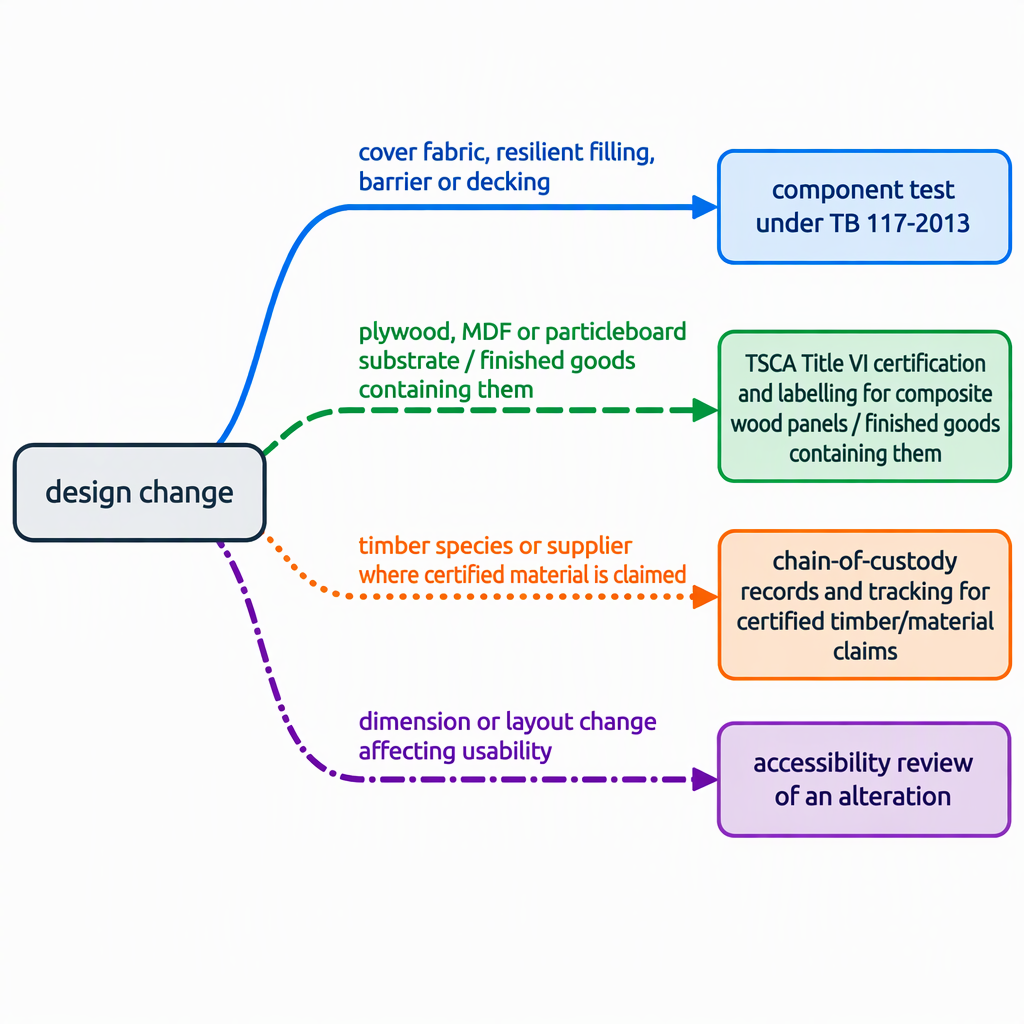
Re-verify whenever the change touches a component your compliance position rests on. Upholstered seating placed on the United States market must meet the TB 117-2013 test method under 16 CFR part 1640, which tests cover fabric, resilient filling material, barrier material and decking material as separate components; a passing barrier may be used where the cover fabric or filling fails, but only because the barrier itself has been tested. A new fabric, foam, barrier or decking material therefore re-opens the test for that component.
Change | Requirement it re-opens | What to obtain before release |
|---|---|---|
Cover fabric substituted on US-market upholstered seating | Component test for cover fabric under TB 117-2013 | Test evidence for the new fabric, and confirmation of any barrier relied on |
Resilient filling — foam or wadding — substituted | Component test for resilient filling material | Evidence for the new filling, and for the barrier where a barrier carries a failing cover or filling |
Barrier material changed, or dropped where one was used | Component test for barrier material | Evidence for the replacement barrier, or another route to compliance if the barrier goes |
Decking material substituted where decking is present | Component test for decking material | Test evidence for the new decking |
Plywood, MDF or particleboard substrate changed, or a finished good restructured around it | Formaldehyde emission standards under 40 CFR part 770 (TSCA Title VI), with third-party certification and labelling | Certification and label evidence from an EPA-recognised certifier for the new panel |
Timber species or timber supplier changed where certified material is claimed | Chain-of-custody identification and tracking requirements | Evidence of the certified volume behind the new material, plus the records that keep the claim valid |
Dimension or layout change that affects how the space is used | Accessibility review of an alteration | A project-specific accessibility review before the change is released |
Two dates set the basis for US upholstered furniture: the requirement applies to items manufactured, imported or reupholstered on or after 25 June 2021, and the certification label has been required since 25 June 2022. A late change to a covered component has to leave that label correct, and the records behind it have to be kept at least as long as the product remains in production.
Do not assume that one passing component covers another. Each component is tested separately, so evidence issued for the original fabric, foam or panel describes that material and does not transfer to its replacement.
Dimensional and layout changes sit in a different place. The Department of Justice regulations reproduced with the 2010 ADA Standards define an alteration as a change affecting usability, including changes or rearrangement in structural parts or elements and in the plan configuration of walls and full-height partitions, while normal maintenance, reroofing, painting and wallpapering are not alterations unless they affect usability. Hotel projects raise accessibility questions that this general definition does not settle on its own, so confirm the applicable requirement with your accessibility consultant or local building department before a dimensional change is released.
Drive the change through one numbered revision and withdraw the superseded one. Tell the factory in writing which revision to build, and take every earlier drawing, schedule, label artwork or finish control out of use.
Where a certified material is part of the specification, documentation is not paperwork for its own sake. FSC chain-of-custody requires certified material to be identified and tracked through manufacturing and distribution, and records of purchase, production and sales to be kept. A change of timber species or timber supplier therefore has to arrive with the records that keep the claim intact, not simply a revised material name on the schedule.
A change request number, the date it was raised and the name of the person who raised it.
The revised drawing or specification, carrying a revision number higher than the released revision.
A short statement of what the superseded revision said, so the difference can be audited later.
The written impact statement and the approval that followed it.
Confirmation that the changed units have passed through the supplier's quality protocol again, ending in the pre-shipment verification before packing.
Re-issued test, certification or chain-of-custody evidence where the change touches a covered component.
Updated label artwork and label records where a mandatory label is affected; for US upholstered furniture the certification label must remain attached through merchandising and distribution, and records have to be kept at least as long as the product remains in production.
The distribution list for the superseded revision, with confirmation from each recipient that it has been withdrawn, plus a retained sample or photograph of the approved finish wherever appearance is the subject of the change.
What can be recovered depends on the operation already completed. Cutting precedes assembly and surface treatment is last, so a change after finishing costs the finished work too. Separate affected units from the rest of the order before anyone touches them.
Stage the affected units have reached | What can still change | What the change consumes |
|---|---|---|
Released, material not yet selected | Material, finish, dimensions and configuration | Drawing and schedule time only; nothing is committed to the line |
Material selected, not yet cut | Material and finish, with dimensions still open | The selected material for the affected units, which may be returned or used elsewhere in the order |
Cut or processed, not assembled | Assembly and finish; a dimensional change means new parts | The processing already performed on the affected parts |
Assembled, not surface-treated | Finish, and fittings where the geometry allows | Assembly work on any part whose material or dimensions change |
Surface-treated | Assembly-level fittings only; a finish change needs re-finishing | The finishing already applied, plus the stripping or remaking that follows |
Packed or shipped | Nothing on those units; the change becomes a separate consignment, a site adjustment or a later phase | The freight, handling and unpacking involved in reopening the consignment |
Hold the affected units instead of the whole order, so unaffected rooms still ship on the original date.
Ask whether the change can be applied to a later room block or phase rather than to finished units.
Check whether the superseded version is acceptable where it stands — in a non-guest area, for example — but only if the designer of record and the brand confirm it.
Recover what you can from superseded parts: cut-down, re-purposing within the same order, or reuse of components the change does not touch.
Agree in writing which party carries each part of the rework before the supplier restarts the line.
Run every late change through one sequence: classify what changes, obtain approvals in order, take a written impact statement, re-verify affected components, and issue one numbered revision before building. The cut-off is the operation already completed.
The cheapest change is one you never make late. Freeze the specification at sample approval, keep one controlled set of drawings and finishes, give the factory one instruction channel, and route every request through the same form. Settle finishes against a physical sample and confirm dimensions against the measured room before release.
These are the questions hotel owners, FF&E procurement teams, designers and contractors ask most often once a change lands after production has started.
Yes, whenever it departs from the released specification. Surface treatment is the final operation, so a finish swap raised late can mean re-finishing parts that were already complete, and a hardware swap can mean re-processing parts if the new fitting is fixed differently. Both are changes, not tweaks to be absorbed quietly on the line.
Not every change, but every change that alters something approved by sample. Where finish, upholstery, filling or a visible component changes, a new sample or finish control keeps the factory from interpreting a description.
Often, yes, and it is usually cheaper than reopening finished units. Phasing the revision into a later room block keeps the earlier rooms on programme, but it has to be a deliberate decision: two controlled revisions, brand confirmation if both versions are visible in guest areas, and a clear record of which room received which version.
That follows the contract and the instruction that caused the change, so it is a commercial question for your own project team rather than a technical one. What you can control is the evidence: a written change request, the supplier's itemised impact statement and a recorded approval keep the discussion on facts rather than recollection.
There is no universal cut-off; the practical limit is the operation the affected parts have already passed. Before cutting, almost anything can still change. After surface treatment, a finish or material change means remaking finished work, and once the order is packed the change becomes a separate consignment or a later phase. Judge it stage by stage.
No. Component test evidence and certificates describe the material they were issued for, and the US upholstered-furniture rule tests cover fabric, resilient filling, barrier material and decking material separately. A new composite wood panel needs its own TSCA Title VI certification and label in the same way.
Keep the change request, the revised drawing with its revision number, the statement of what the superseded revision said, the impact statement and approval, any re-issued test or certification evidence, updated label artwork, and the list of people who held the superseded revision. Where certified material is claimed, purchase, production and sales records have to be retained as well.
If the change touches a component a mandatory label covers, yes. A US upholstered-furniture certification label has to stay attached through merchandising and distribution, and the records behind it have to be kept at least as long as the product remains in production; a TSCA Title VI label is likewise tied to the panel that was certified. Treat label artwork as part of the revision, not as a packing detail.